Strengthening trade partnerships through construction intelligence
share


The relationships between a contractor and its trade partners are important. They can also be fragile. One dispute, one bad experience and a relationship can be soured, even terminated – a dire outcome in a world where labor shortages have turned effective partnerships into prized possessions.
It’s something Wilson Haworth, Director of Virtual Design and Construction for Juneau Construction Company, touched on during a recent webinar with Buildots. In sharing his experience leveraging construction intelligence across multiple projects, Haworth explained how using Buildots has helped Juneau organize trade activities throughout its portfolio while simultaneously improving collaboration, minimizing disputes, and ultimately driving shared value through money and time saved.

“We pay for work in place, (trade partners) pay by the man and hour. That’s how they’re going to really help their bottom line.”
Wilson Haworth, Director of Virtual Design and Construction, Juneau Construction Company
Objective data as a foundation for trust
A construction intelligence platform like Buildots puts objective progress data in front of everyone on site, and that level of transparency can meet resistance. Trade partners in particular may worry that new visibility into their work will be used to scrutinize, or even punish them. But, when rolled out thoughtfully, it impacts (and benefits) not just the contractor or owner deploying it, but every individual stakeholder involved in building. Haworth understood this instinctively, from the start of his Buildots roll-out: “The value proposition for any technology implementation isn’t going to be realized until our trade partners get addicted to that data,” Haworth said. “We can’t build these sustainable workflows until everybody’s on it and it’s part of the experience.”
Makes expectations clear: Teams can show a trade where it is expected to be, such as “you should be at 100% by next Wednesday, but you’re currently at 40%”, helping both sides align on realistic commitments.
Reduces disputes and wasted time: By documenting progress and site reality, Buildots helps teams spend less time arguing about status and more time resolving issues. It also provides historical data that can support productive, non-confrontational discussions about progress, payment applications, claims, or change orders.
Not just tracking performance, but influencing it
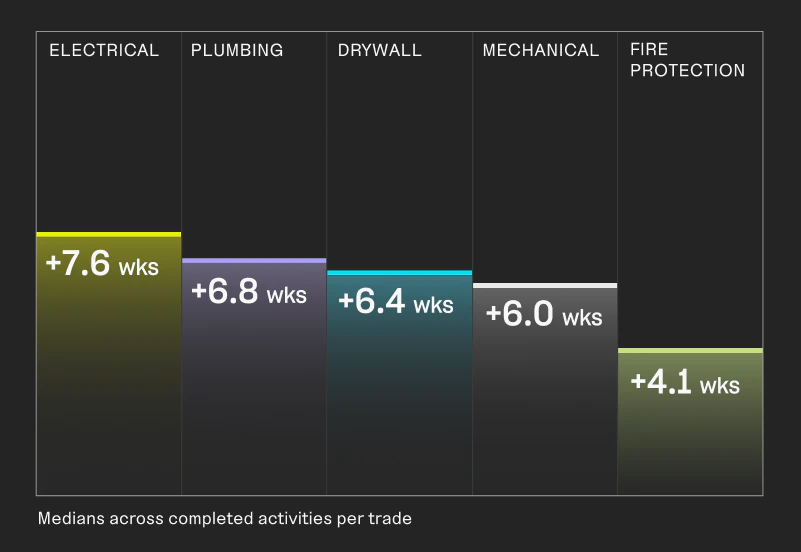
As the Buildots Intelligence Lab’s recently published Global Construction Benchmarks Report has shown, the effectiveness of trades can fluctuate greatly. And that’s not necessarily a knock on those companies or crew. Maybe it’s because of below-average output week over week, or mis-sequencing in the schedule, or a fundamental misunderstanding of who should be doing what, where and when onsite – all things that can be managed through a construction intelligence platform. Regardless of the reason, it’s the reality.
In a review of drywall, fire protection, plumbing, mechanical and electrical trade performance across 200 individual projects, we found a 26-percentage-point difference between the most on-time trade (ie, drywall) and the least (ie, electrical).
Haworth believes that putting objective data, a single source of truth, and clear jobsite visibility – whether by zone, trade, or sequence – into the hands of his trade partners provides an opportunity to boost performance and bottom lines. While contractors, owners and subcontractors have different though equally important roles on jobsites, what they all unfortunately share is a lack of visibility. None has a clear line of sight into what is happening on a build. Mostly, they rely on subjective reporting rather than accurate progress data. Access to that sort of dependable data is valuable to each of those stakeholders, but Haworth believes it’s especially beneficial to subcontractors because of their proximity to the work being done in the field.
“Importantly to me is getting this to the people who actually change it, which are the trade partners.”
Boosting every stakeholder’s bottom line
Haworth says that trade partners, like all construction companies, typically define success for themselves in two ways: schedule milestones and/or budget overruns. The issue is that defining success by what’s already happened means reduced agency on whether you end up winning or losing.
“Those are lagging indicators,” he explained. “If your project’s behind schedule or over budget, you’ve already run into a problem. You can’t really change it there.”
In Haworth’s experience, Buildots provides the data and visibility necessary to properly and regularly track, evaluate, and forecast site productivity and progress, allowing teams to adjust schedules and output to avoid said schedule delays and budget overruns – which, as he explained, is particularly important for trade partners.
“We pay for work in place, they pay by the man and hour,” Haworth said. “That’s how they’re going to really help their bottom line.”
It’s also going to help the partnership. Delivering a consistent, data-driven approach across every project, he said, garners a reputation of dependability among trade partners.
“We’re not going to have as many delays,” Haworth explained. “We’re going to have everything ordered, and I don’t have to carry as much contingency for the risk of the unknown, because we know Juneau runs these projects really well.”
Curious how trade performance compares across 200 projects? Join us live on Wednesday, November 18 to explore the Global Construction Benchmarks report with experts from the Buildots Intelligence Lab, sign up here.
Related Reading
A marriage made for construction: Bringing progress and workforce tracking together
Construction intelligence: how leading GCs use AI and project data to transform decision-making
Billion-dollar decisions require construction intelligence