Construction intelligence: how leading GCs use AI and project data to transform decision-making
share


Insights from Greg Dunkle (COO, STO Building Group), Amir Berman (VP, Industry Transformation, Buildots), and Erez Dror (VP, General Contractors, Buildots)
The construction industry has no shortage of data. Reality capture, BIM, master schedules, RFIs, workforce tracking, and ERP systems can generate millions of data points every week.
Yet, when projects face disruptions, project teams often struggle to answer the critical questions:
- Where exactly is the schedule risk emerging?
- Which trades are falling behind today?
- What specific decision should we make right now to avoid a costly delay next month?
The reality is that construction data is everywhere, but data-driven decision-making remains notoriously difficult.
According to construction leaders from Buildots and STO Building Group, the next major competitive edge for construction companies won’t come from simply collecting more field records or adopting ad hoc AI tools. It will come from combining these systems to build a new layer of operational capability: construction intelligence.
‘Construction intelligence’ is the ability to analyze and interpret construction data at scale – and “scale” is the operative word. Insight into a single project helps that project; datasets that span an entire portfolio change how a company operates. When leaders can see performance patterns across dozens of projects, they can rewire processes at the enterprise level and ultimately shift how the industry itself runs.
In this article, we’ll examine why the construction industry has struggled to capitalize on AI, what stands in the way of data-driven decision-making, and how construction intelligence gives general contractors a competitive edge.
| Key takeaways: Construction’s AI gap is really a data gap: physical work often lacks digital representation, so AI can’t reason over it without a layer that first captures accurate site data. Most contractors capture site data but use it to document the past – not to predict risk or drive decisions. The future of construction management will be led by teams that use construction intelligence to take a more proactive approach. Insights get sharper as datasets connect: progress, workforce, logistics, and materials data combined answer why work is behind, not just that it is. Portfolio-wide production benchmarks can turn siloed project data into broader strategic insights that influence pricing, trade vetting, and improvement plans – without adding reporting workload for field teams. The payoff for owners: predictability of outcomes. The general contractors implementing construction intelligence capabilities now are the ones that will earn owners’ trust, secure future work, and enhance their margins. |
Why has construction been slow to benefit from AI?
AI has reshaped legal, medical, and tech because those industries already run on digital information – AI can read the contracts, the records, the code.
Construction is different: the work is physical, and most of it never becomes codified as usable data – and manual reporting is slow, subjective, and incomplete. As Amir Berman, VP of Industry Transformation at Buildots, explains:
“The thing is that in construction… what you all produce doesn’t have a lot of digital representation except for some scattered manual reporting.”
The conclusion: construction’s AI gap is actually a data gap. Data, Berman noted, “needs to exist, and it has to be accurate” for AI to support it.
Closing that gap requires a new layer of technology that is purpose-built to capture objective, highly accurate field data – and unify it with schedule, BIM, and workforce data within a single connected data model. That combined picture is what makes actionable construction intelligence possible.
Data accuracy isn’t optional here. As Greg Dunkle, Chief Operating Officer at STO Building Group (STOBG), puts it: “Bad data in is only going to produce bad data out.”
Without data hygiene and governance, even the most sophisticated AI tools can’t support an organization toward real construction intelligence.
And a single accurate dataset still isn’t enough. Reality capture might confirm that site work isn’t progressing on schedule. But understanding why a delay exists requires more context – progress data combined with schedule, BIM, and workforce data – so teams can identify root causes. That joined-up data model underpinning the analytics is what separates real construction intelligence from siloed reporting tools.
Using data for documenting the past vs. anticipating what’s next
Most construction organizations capture site data but use it primarily for documentation. Far fewer use it to inform decisions or address risk. (A live audience poll during our recent webinar, “What Will Construction’s Intelligence Era Look Like?”, reflected exactly this “documentation only” pattern among GCs and project owners.)
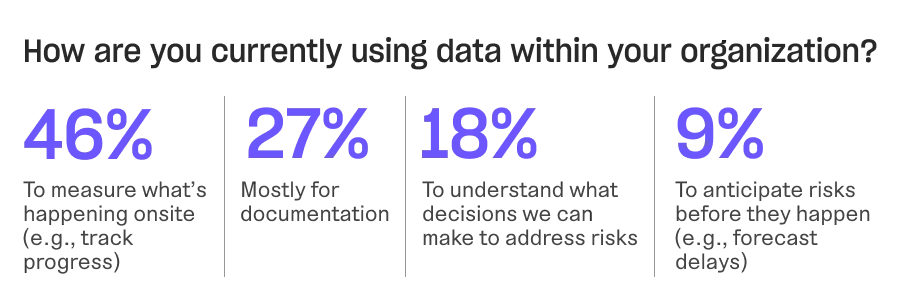
Construction intelligence elevates project data from a simple record of what happened into an actionable, enterprise-wide system for predicting and mitigating risk, identifying opportunities, and guiding better decisions.
Berman describes the shift as companies moving from “data that documents, like lagging indicators, and what already happened, to the era of intelligence” – using that same information in new ways to identify risk, pinpoint which trades are holding a project back, and clarify which decisions will move the needle to keep projects on schedule, on budget, and on spec.
Dunkle put it in field terms. Every superintendent or project manager approaches problems differently, each relying on their own “secret sauce” of experience and intuition to make a project successful. That individual know-how works, but it doesn’t scale, and it leaves foresight to instinct.
To help usher in the new era of construction intelligence, he argued, we need to show field teams that “there are tools out there that can help them see a wave coming before it hits them at 5 AM when they open the gate.”
| Legacy construction data practices → | Documents the past (lagging indicators) |
| Construction intelligence → | Anticipates the future (leading indicators) |
The goal of building out construction intelligence capabilities isn’t about better reporting; it’s about better decisions. It helps teams move from a reactive to a proactive approach to construction management.
Dunkle described the value of looking several moves ahead instead of reacting after problems appear:
“The ability for folks to learn faster, to implement that data quicker, [to play] chess versus checkers, where you’re five, six, seven moves out and you see how the game’s gonna end before it starts, is hugely important.”
That’s a useful way to think about construction intelligence.
Traditional building site reporting asks:
What happened?
Construction intelligence goes further to ask:
What’s likely to happen next – and what should we do about it?
How real general contractors are implementing construction intelligence today
When building out its construction intelligence capabilities, STO Building Group didn’t start with AI – it started with data. The company launched its data group about four years ago, first organizing the information flowing from more than 160 separate applications: “It used to be a data lake, now it’s a data ocean,” Dunkle said. Then came data hygiene and governance, because “bad data in is only going to produce bad data out.”
On that foundation, STOBG built dashboards spanning safety, project performance, business-unit performance, and regional performance.
Next up: an “operations command center” that surfaces stress signals across their entire construction portfolio – safety risk, schedule, cost, payment terms, RFIs, changes – so leadership can marshal resources to the jobs showing strain before they slip.
But Dunkle is clear that the hardest part of establishing a construction intelligence function isn’t technical, it’s cultural. He compares the shift to the industry’s safety journey – a culture change that means “really trying to ingrain in people that there’s a different way to do it, to wake up every day and make a decision that day to do it differently.”
The goal of all this work isn’t just to produce better reports for the head office. It’s to provide an edge for the people building the project in the field, too.
“My job is to help our boots on the ground, in our offices, have a better experience,” Dunkle explained. “And I think with data being provided in a way that gives them an opportunity to play chess instead of checkers, we’re gonna [be a] stronger organization and a stronger industry.”
Some contractors might be waiting for a clear winner to emerge before investing in construction intelligence technology. Dunkle sees that as the riskier path. With AI tools evolving daily, STOBG tests several at once and adapts as it learns — “if you’re sitting there waiting for the final solution and you’re not participating [now], it’s gonna be a problem.”

“My job is to help our boots on the ground, in our offices, have a better experience. And I think with data being provided in a way that gives them an opportunity to play chess instead of checkers, we’re gonna [be a] stronger organization and a stronger industry.”
Greg Dunkle, COO at STO Building Group
More than a dashboard: how construction intelligence platforms bring senior project manager-level insights at scale
For Erez Dror, VP of General Contractors at Buildots, the meaningful benchmark for construction intelligence technology today is this: a platform should deliver insights “at least [at] the level of a senior PM.”
And to reason like a senior project manager, a system needs what a senior PM has – context.
“It’s not enough to see one piece of the puzzle,” Dror said. “The more pieces you see, the more datasets you have, the better the insights you’ll be able to deliver.”
Drawing on his background as a former construction project manager, Dror points out that a delay alert is only the starting point – it requires a follow-up investigation to understand why it occurred. A PM doesn’t just ask what is delayed; they check crew sizes on site, trace material lead times, and audit pending RFIs to discover the cause. Connecting these datasets in a construction intelligence system automates that inquiry, transforming raw alerts into root-cause answers.
Each dataset you connect to your construction intelligence platform moves the diagnosis a layer deeper – from spotting the symptom to isolating the root cause.
Buildots’ Amir Berman described the data model that makes advanced construction intelligence technology possible “like a Swiss Army knife.” It connects multiple tools and data sets in a single solution with a wide breadth of context and uses. Once BIM, schedule, reality capture, and workforce data are connected, every new source of information added to the system plugs into all the others at once. That hyper-connection points to where the technology is headed: use cases like flagging a delay risk months in advance, so a specialist team flying in for a scheduled slot doesn’t arrive to find the work isn’t ready – an ambition platforms are actively building toward today.
Why can’t you get there by stitching together point solutions? Because the pieces rarely fit. “When you’re trying to put different data sets together – and trust me, I’ve tried a lot in the past – if the structure is not the same, it can become impossible,” Dror explained. The advantage of a purpose-built construction intelligence platform is standardization: all project data is captured in a consistent structure, so the datasets connect easily and can start providing insights right away.

“It’s not enough to see one piece of the puzzle. The more pieces you see, the more data sets you have, the better the insights you’ll be able to deliver.”
Erez Dror, VP, General Contractors at Buildots
How cumulative project data influences company-wide strategy
Scaling data-driven insights beyond a single jobsite to achieve a company-wide operational advantage is one of the biggest challenges firms face as they prepare for the new data-driven era of construction intelligence, according to Berman. This is because organizations need their data to do two things at once. Project teams care about one thing (delivering their immediate job safely and successfully), while leadership needs another (standardized measurement across every project in the portfolio to build benchmarks and improve processes).
Establishing a construction intelligence function at the enterprise level helps resolve that tension between site and headquarters: if progress is captured against planned production curves on every project anyway, company-level benchmarks emerge automatically over time, “without adding too much work on the project team,” says Berman.
Berman shared a real example of what those benchmarks can reveal at both the project and company levels. For one HVAC activity measured across multiple projects, the median planned production rate was just under 1,600 feet per week. The median actual delivery: about 850 feet.
A project team uses that data around what is planned vs. produced in one way – optimizing the job in front of them. But viewed at the company level, Berman said, the same information unlocks a different class of decisions: more accurate future scheduling, greater predictability when negotiating with trade partners or owners, and long-term improvement plans to close the gap between planned and delivered production.
The portfolio-wide view also cuts across markets, not just projects. For a GC like STOBG – 14 operating companies with deep portfolios in sectors like healthcare and data centers – the same data can be sliced by market sector across every business unit. As Jessica Herrala, VP North America at Buildots, put it: “If they want to track all healthcare [projects] across all 14 organizations… being able to utilize this data, that’s the magic.”
The real ROI of construction intelligence: time, predictability, margins
For Dunkle, the business case for construction intelligence doesn’t start with dashboards or dollars – it starts with people. “The ROI is really looking to give back time for our employees in a manner in which they have a better use of that time.”
His example: on large projects, manual progress updates can consume a superintendent’s time on walks that “may or may not have subjective analysis” attached. Automated capture, like using Buildots tools or Buildots site capture services, to collect site data, hands that time back. Sometimes, the better use of their time is professional, allowing for deeper planning cycles with trade contractors and the owner. Sometimes, Dunkle says, it’s personal: letting a super “actually get home and make that softball or baseball game with their children.” In an industry fighting a war for talent, both matter.
The ROI extends to the client relationship, too. Spending budget on higher-value work makes a GC “a more valuable partner to the client, because we have spent their money wisely when it comes to managing a project.”
And that’s what owners are ultimately buying when they select contractors: certainty. Whether it’s a $5,000 weekend renovation or a multi-billion-dollar campus, Dunkle said, clients want “reliability and predictability of their job being done safely, under budget and on schedule” – and increasingly, they expect their GC to prove it. Having the right construction intelligence systems in place helps them do just that.
The bottom line: construction intelligence is the industry’s new operating model
The next competitive advantage in construction won’t come from just collecting more data or bolting AI onto old workflows. It will come from establishing construction intelligence as a core operational capability: accurate jobsite data, connected across progress, workforce, schedule, and BIM, powering decisions at every level – for the superintendent planning tomorrow’s work on site and the executive pricing next year’s bids. Teams that embrace this new data-driven operating model get to play chess instead of checkers: seeing several moves ahead and acting before risk becomes reality. Teams that wait will be left asking where their margins went.
Construction’s intelligence era is being defined right now – by the companies building the capability before the final playbook is written.
See how leading GCs put construction intelligence to work: watch the full conversation with STO Building Group and Buildots here
Related Reading
Billion-dollar decisions require construction intelligence

Construction workflows that work: Progress reporting and risk management between owners and contractors

Data analytics in construction: Why a lack of structured data is stalling AI’s takeoff