A marriage made for construction: Bringing progress and workforce tracking together
share


There are plenty of good reasons to know who’s doing what and where on a jobsite.
We’re not necessarily talking about names here, but crews, roles and headcounts. Understanding a jobsite’s real-time makeup can, for instance, reduce risk – to safety, schedules, and budgets. It can also create opportunities to optimize schedules, sequencing and crew composition.
In short, workforce tracking comes with measurable benefits. So, why, as an industry, are we not very good at it?
In a recent webinar, Buildots VP of North America Jessica Herrala and VP of General Contractors Erez Dror sat down with Wilson Haworth, Director of Virtual Design and Construction for Juneau Construction Company, and broached that very question. More than that, they discussed how and why Juneau has found a way to do it better.

“The problems it’s solving are the problems we were trying to solve anyway.”
Wilson Haworth, Director of Virtual Design and Construction for Juneau Construction Company
A tradition of manual tracking and static data
“It’s something we still do very manually,” said Haworth, acknowledging the industry’s current approach to workforce tracking.
In a poll conducted live during the webinar, audience members were asked, “How are you currently tracking workforce on your projects?” Half are either asking their foreman for a daily headcount or manually doing it themselves, typically logging the information in spreadsheets or something similar. 42% are pulling data from access control systems or turnstiles. Eight percent simply didn’t know.
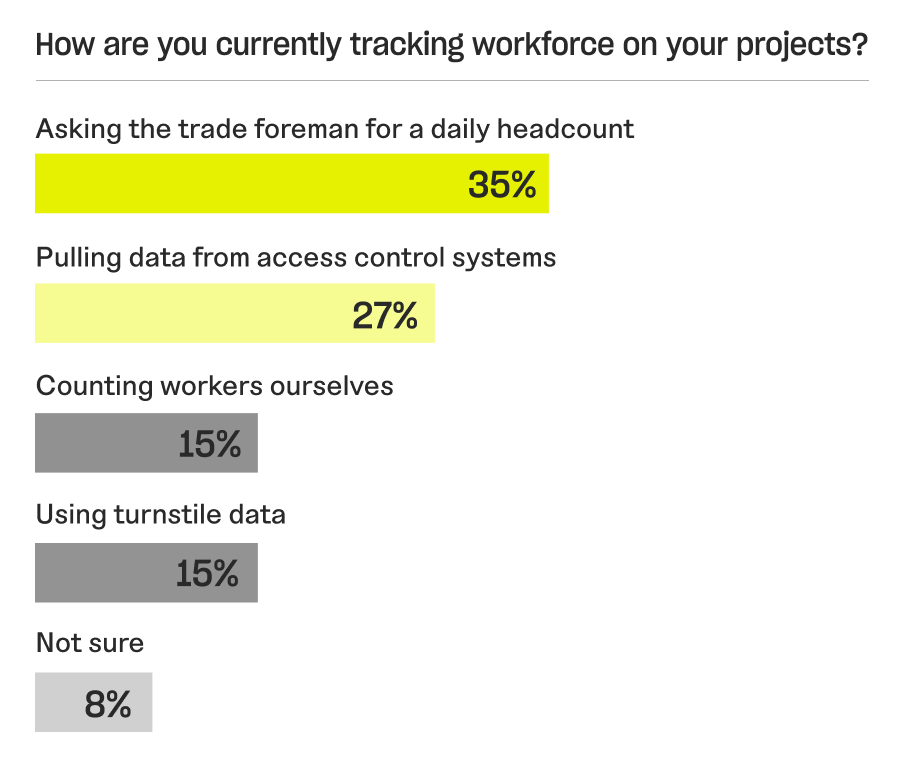
The throughline is that the information is largely collected manually and is, for the most part, static. At best the data is limited, at worst it’s risky.
“Construction sites can be surprisingly porous. People can come in and out surprisingly easily,” Haworth said. “There shouldn’t be a reason that a site with all of its inherent hazards and complexities should be, you know, accessible.”
Identifying a need for intelligence
The workforce tracking challenge is something Juneau had been specifically looking to solve for some time, a need rooted in safety.
“In the case of an emergency, we need to be able to notify (whoever’s) on site,” Haworth said. “You can’t do that if you don’t know who’s on your site.”
At the same time, workforce tracking was a natural fit for Juneau. The company has a strong tendency to solve problems – or at least inform decision making and strategy – through the application of intelligence.
“This really ties into some of our goals as a company,” Haworth said, “how we want to understand data.”
That inclination to better understand the jobsite is what initially led Juneau to adopt Buildots. It started with production data, Haworth explained, where the company was able to completely reframe its thinking around delays. They went from a risk you could only mitigate to one you may be able to avoid completely.
“In the case of an emergency, we need to be able to notify (whoever’s) on site. You can’t do that if you don’t know who’s on your site.”
Wilson Haworth, Director of Virtual Design and Construction for Juneau Construction Company
Connecting the data dots
The initial request for actionable data to be delivered daily led Juneau to two possible solutions.
“Either we document the site 24-7 and process data to get production data on a minute-by-minute basis,” explained Haworth, noting the particular difficulty of that given the size of some of the company’s projects. “Or we tie it to the other input, which is the manpower, and start to look at data and progress in terms of the amount of work that’s being done on an individual basis, and fill in that gap with the production of the individual workers.”
Haworth used Juneau’s ōLiv Columbia project as an example. It’s a housing project the company is doing with Core Spaces Development for the University of South Carolina, one of the biggest of its kind in the U.S.
“The floor plate’s over an acre,” he said, “just to put that into perspective.”
The project combines two structures, a 27-story cast-in-place housing tower with a 15-story precast parking garage next to it. Altogether, it’s a bit over a million square feet of heated space and will include 723 units to house approximately 2,300 people.
“There’s a lot of walls (and) doors in between us and being able to have visibility into where the work is going in place and where people are on site,” added Haworth
It’s a project so large, and with so many crews working onsite simultaneously, that Juneau couldn’t keep up with tracking progress or workforce manually. It’s one of the reasons why the company turned to Buildots Field, a data layer, part of the Buildots platform, that provides immediate productivity intelligence, improved safety and clearer communication. Through an easy-to-use app, leaders on and off site can see site-wide attendance in real-time, with hazard reporting and multiple logistical and operational solutions built in.
“Now we’re tying that productivity from a GC standpoint (ie, what production is being done) to that trade standpoint, which is how much work is being done by person, by hour, (and by) what zone’s they’re working in,” Haworth said.
He described the workforce tracking data as the “canary in the coal mine.” While the week-by-week progress data helps Juneau establish weekly action plans, it’s the real-time worker data that allows the company (including project managers and trade partners) to understand whether the project, on any given day, is trending towards that plan.
“When we know where that manpower is, we do get that sense, that early indicator that … we’re turning towards a problem.”
Not only has Buildots Field given Juneau the daily insights it needs to avoid potentially devastating delays, Haworth explained, but the app’s additional functionalities are leading to efficiencies elsewhere. The app offers a range of safety and communication options like digitized safety orientation, daily forms, and permits. Or, in the event of an emergency, team leaders can even issue an immediate site-wide evacuation order.
Being able to call the buck hoist, for instance, something that Juneau (as well as many other GCs and crews) have long struggled with, has improved.
“The other day, the average hoist wait time was two and a half minutes,” said Haworth, explaining how deliveries are now being scheduled through Buildots Field. “It adds a level of structure and organization that we’re seeing measurable wait time decreases on.”
As Haworth puts it, Juneau has become “addicted” to data. So much so that it’s planning to leverage the intelligence provided by Buildots and Buildots Field into other parts of its business.
“It’s not just indicators for workers and manpower,” he said, “but it’s indicators for your ancillary departments, (like) your VDC department, to know, ‘Have we coordinated that level in time?’”
Today, Juneau has deployed Buildots and Buildots Field together on nine active projects. And why do they keep turning to Buildots? Simple.
Said Haworth: “The problems it’s solving are the problems we were trying to solve anyway.”
Learn more about Buildots Field

Related Reading
Construction intelligence: how leading GCs use AI and project data to transform decision-making
Billion-dollar decisions require construction intelligence

Construction workflows that work: Progress reporting and risk management between owners and contractors