Why data center construction schedules fail – and how to build more predictable projects at scale
share


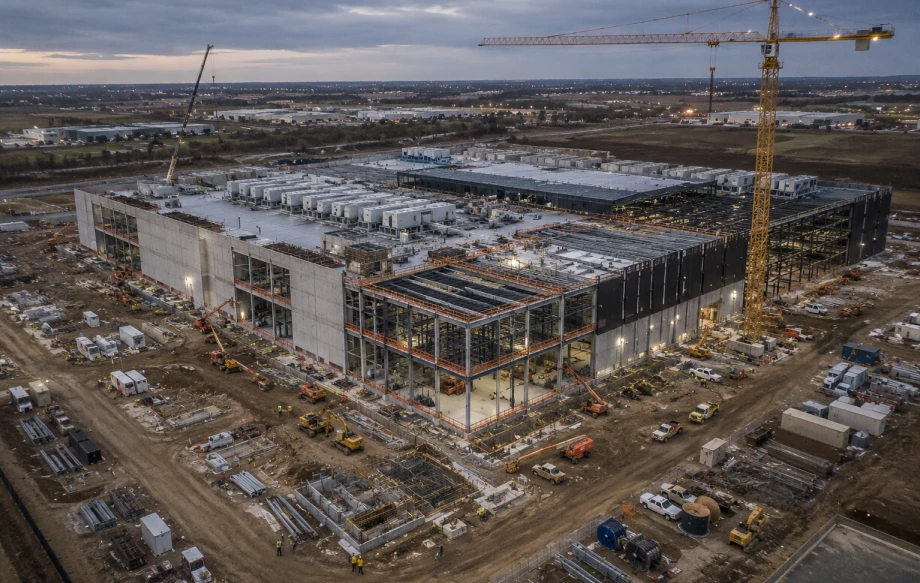
Today’s data center construction boom has owners and contractors racing to deliver increasingly complex facilities on compressed timelines. When schedules slip, the industry’s attention typically turns to performance in the field — crews, productivity, site conditions. But the biggest delivery risks may be built into your schedule long before ground is broken, hidden in unrealistic trade production rates, unexamined sequencing, and plans disconnected from actual physical quantities.
Drawing on insights shared by Kushal Dagli (Global Data Center Deployment Optimization Lead at Microsoft) and Amir Berman (Vice President of Industry Transformation at Buildots), this article explores why traditional data center construction schedules fail – and how data-driven benchmarking, simulation exercises, and shifting toward a repeatable production mindset can bring more predictability to complex builds.

“We used to talk about speed to market as a competitive advantage [in data center construction]. I think now it’s almost a requirement.”
Kushal Dagli, Global Data Center Deployment Optimization Lead at Microsoft
To identify and mitigate schedule risks from the outset, some leading data center owners and general contractors are adopting a new data-driven approach to construction scheduling. (Or, as we like to call it, schedule intelligence.)
| Schedule intelligence is a data-driven planning approach that helps validate construction schedules before execution. It layers data from comparable projects (like quantity data, anomaly detection data, and performance benchmarks) onto a schedule to turn a static plan into a risk-aware model of how work is likely to actually flow. |
Rather than relying on assumptions, overly optimistic production rates, or static planning documents, teams are beginning to rethink scheduling as a part of a continuously validated production system – one informed by real-world performance data.
| Key takeaways: why data center construction schedules fail (and how to fix them) |
|---|
| Why do data center construction projects slip off schedule? Delay risks are often embedded in the schedule itself (due to quantity blindness, unverified production rates, and untested sequencing) before site work even begins. |
| What is schedule intelligence? A data-driven planning approach that layers BIM quantities, anomaly detection, and historical production benchmarks onto a schedule, turning a static plan into a risk-aware execution model. |
| How big is the plan-versus-reality gap in data center construction? On data center projects measured by Buildots, actual weekly trade output typically falls 20–50% below plan; 78% of webinar attendees admitted their schedules probably aren’t built on realistic rates. |
| What can teams do to achieve on-time delivery of data centers? Treat data center delivery as a repeatable production system, validate schedules against measured benchmarks, and simulate delivery scenarios months before mobilization. |
| What cultural shift is required for better data center schedule adherence? Use data to enable earlier decisions between owners, GCs, and trades – not to keep score. |
Watch the full data center scheduling conversation with experts from Microsoft and Buildots here →

“Everyone is trying to come up with new and innovative ways to be able to put their foot on the accelerator and build as fast as possible.”
Kushal Dagli, Global Data Center Deployment Optimization Lead at Microsoft
Why do data center construction schedules fail before work even begins?
Data center projects combine compressed delivery timelines with enormous mechanical and electrical complexity, while labor shortages, supply chain constraints, and rapidly evolving owner requirements leave little room for error. These pressures can push teams to postpone delay risk problem-solving until after construction starts. But Dagli and Berman argue that many of the most significant delay risks are embedded in the project schedule before site work even begins.
Construction schedules are prone to failing because they frequently rely on assumptions that have never been validated against actual field production.
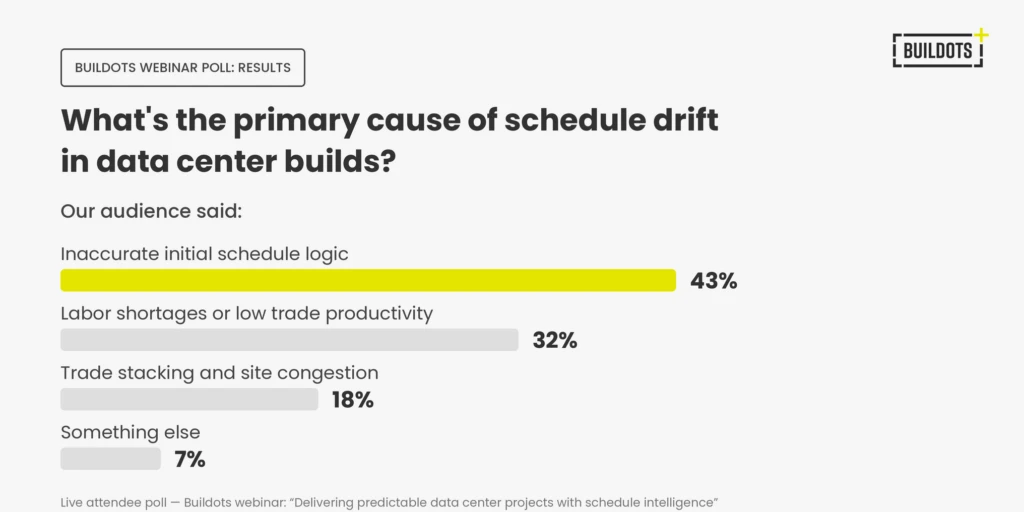
When attendees at Buildots’ schedule intelligence webinar were asked to name the primary cause of schedule drift in data center builds, the top answer — chosen by 43% — was inaccurate initial schedule logic.
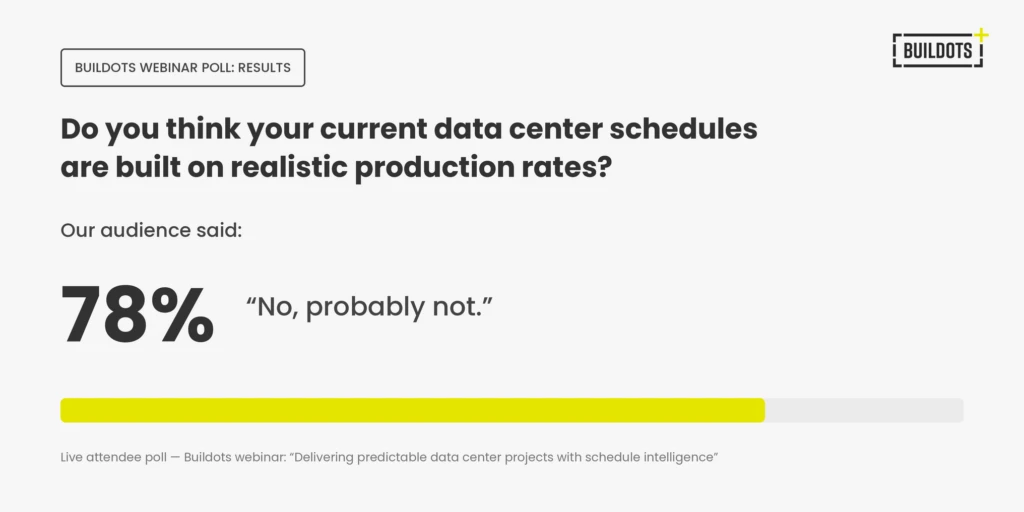
A second audience poll cut deeper: asked whether their current data center schedules are built on realistic production rates, 78% said: “No, probably not.”
Dagli explains what’s behind those numbers:
“Typically, in your Gantt schedules, you don’t have productivity baked in, you don’t have space constraints baked in, you don’t have flow and the interface of trades baked in. And when you don’t have these things, you can’t view it as a production system, you can’t create the feedback loops at the different points in time, and that’s what leads to the challenge between what exists in reality and what was planned.”
Without those elements, the schedule is an abstraction rather than a model of how work will actually develop through the site – and, Dagli says, “this gap just keeps widening as the project progresses.”
When a project schedule contains unrealistic production assumptions, project teams might spend the remainder of construction reacting to problems that were effectively designed into the plan from day one. The result isn’t simply missed milestones; it creates cascading effects across procurement, trade coordination, commissioning, and owner expectations.
2 primary disconnects between data center planning and production reality
Berman traces the data center schedule adherence problem to two specific disconnects that show up in the planning phase:
- Quantity blindness. Schedules are often disconnected from the quantities outlined in the model. The exact quantities required for each activity often never make it into the plan, so no one knows how much work each task bar actually represents.
- Unverified production rates. Even when quantities are included in the schedule, most teams have no objective reference to determine whether the assumed weekly pace is achievable.
“This is the result of the industry working in different parts of your software that are not necessarily connected,” Berman says, “So you’ll have your VDC team working on coordination and making sure the models are correct, and, on the other side, you’ll have the scheduling team working on their schedule, but no one connects it [to the actual BIM]. Once it’s connected, now both teams can actually decide how to deal with things.”
How to fix schedule delays in data center construction: production systems, schedule intelligence, and simulation testing
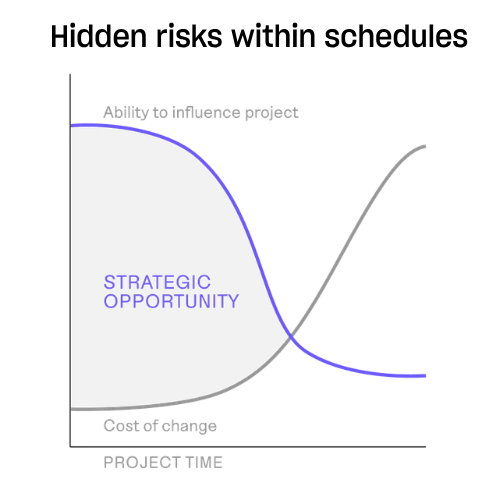
The good news: none of these schedule failures are inevitable in data center builds. If some of the biggest delay risks are embedded in the schedule itself, they can be surfaced and resolved before ground is broken, no crystal ball required.
Throughout their conversation on data center construction schedules, Dagli and Berman laid out practical advice for a more data-driven approach to scheduling, built on five pillars:
- Treat data center delivery as a repeatable production system.
- Layer schedule intelligence capabilities onto your master plan.
- Identify unrealistic planned output spikes in your schedule.
- Use actual historic production benchmarks in your plan.
- Pressure-test delivery scenarios with data-driven simulation.
Here’s how each works in practice.
1. Create repeatable production systems for data center builds
To overcome systemic schedule drift in data center projects, some hyperscale developers are changing how they deliver projects and moving toward a production-system approach.
Dagli recommends starting with a mindset shift: at today’s scale of demand, data centers shouldn’t be planned as unique, one-off projects. Instead, he says, data center project teams need to develop repeatable production systems that can scale across an entire portfolio.
“We have to start to look at the way that we execute these data centers, not from an abstract planning perspective but to look at them as a production system… that’s when you start to understand all of these different risks and uncertainties, and you can build those uncertainties into your plan.”
Kushal Dagli, Global Data Center Deployment Optimization Lead at Microsoft
At hyperscale, variability is another primary driver of project risk. When organizations treat every job as a one-off build, institutional learning resets with every groundbreak. “Your ability to learn, to benchmark, and to systematically leverage that is sort of gone,” says Dagli.
Viewing data center delivery as a repeatable production system instead of isolated projects ensures that every project provides empirical data to optimize future builds.
There’s more consistency across data center builds than local site differences might suggest. Drawing on a decade of studying construction projects across companies and regions, Dagli estimates that “70 to 80% of the [activities] within a particular project type are pretty repeatable, if you really look at it.”
That repeatability is an asset, if teams treat it as one. Standardizing delivery for repeatable scope lets organizations build historical benchmarks, replace pre-construction guesswork with verified reference data, and turn one-off projects into a predictable pipeline.
The catch: institutional learning rarely travels on its own. The same construction crews seldom move from region to region, so the knowledge gained on one build doesn’t automatically reach the next. Technology has to fill that gap with a learning system and benchmark data that travel across projects even when people can’t.
“Data is the enabler for you to then make decisions and be able to continuously improve from project to project,” says Dagli.
2. Add schedule intelligence to your capabilities and tech stack
Schedule intelligence is the practice of enriching a master schedule with real production data – quantities, benchmarks, and historical output rates – so it reflects how work actually gets built. Delivered through AI-enabled construction technology like Buildots, it converts a static plan into a living, risk-aware execution model.
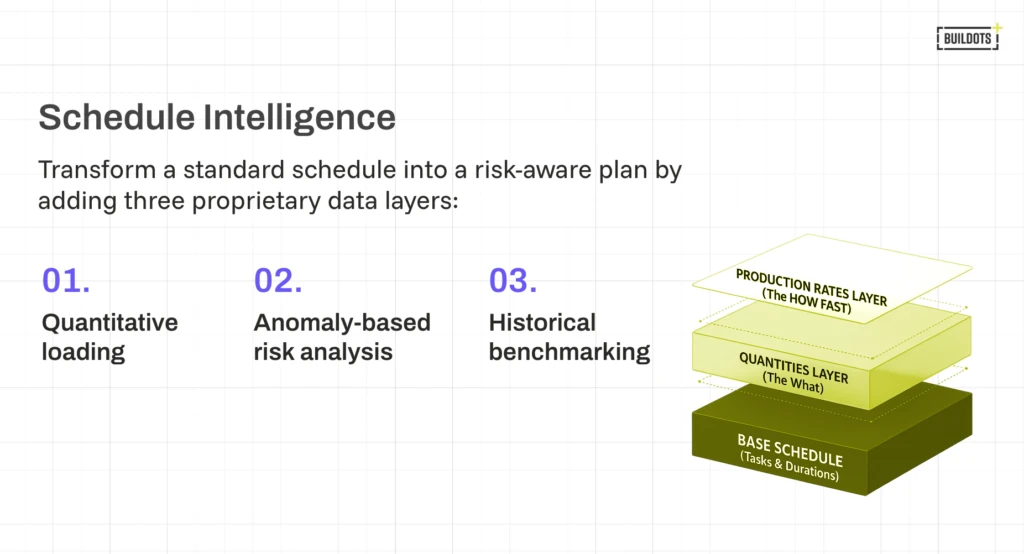
An effective schedule intelligence approach integrates three data layers:
| Data Layer | Function | Primary Value Delivered |
| 1. Your Base Schedule | Standard CPM logic links tasks and planned durations. | Establishes the planned sequence of work. |
| 2. Quantities Layer | Extracts high-LOD BIM element data and maps physical quantities to schedule tasks. | Eliminates “quantity blindness” in schedules by defining the exact work volume required per task. |
| 3. Production Rates Layer | Applies empirical output rates and historical benchmarks to planned quantities over time. | Validates whether the weekly trade output targets built into your schedule are realistic. |
3. Spot unrealistic planned output spikes
When model quantities are mapped across schedule timelines, it’s easier to surface any hidden operational anomalies or production assumptions that are unlikely to hold up on site.
Berman illustrated this with an anonymized example from a real project: an electrical roughing activity whose planned weekly output ramped from around 300 linear feet to a steady mid-project rate, then suddenly demanded a spike to 1,400 linear feet in a single week before dropping right back down the week after.
On a standard Gantt chart, none of this was visible; the activity read as one continuous, healthy bar. Quantity loading exposed the spike — and the question no one had asked: can this trade actually double its output for one week? Does that take more manpower, and is there physical space for it?
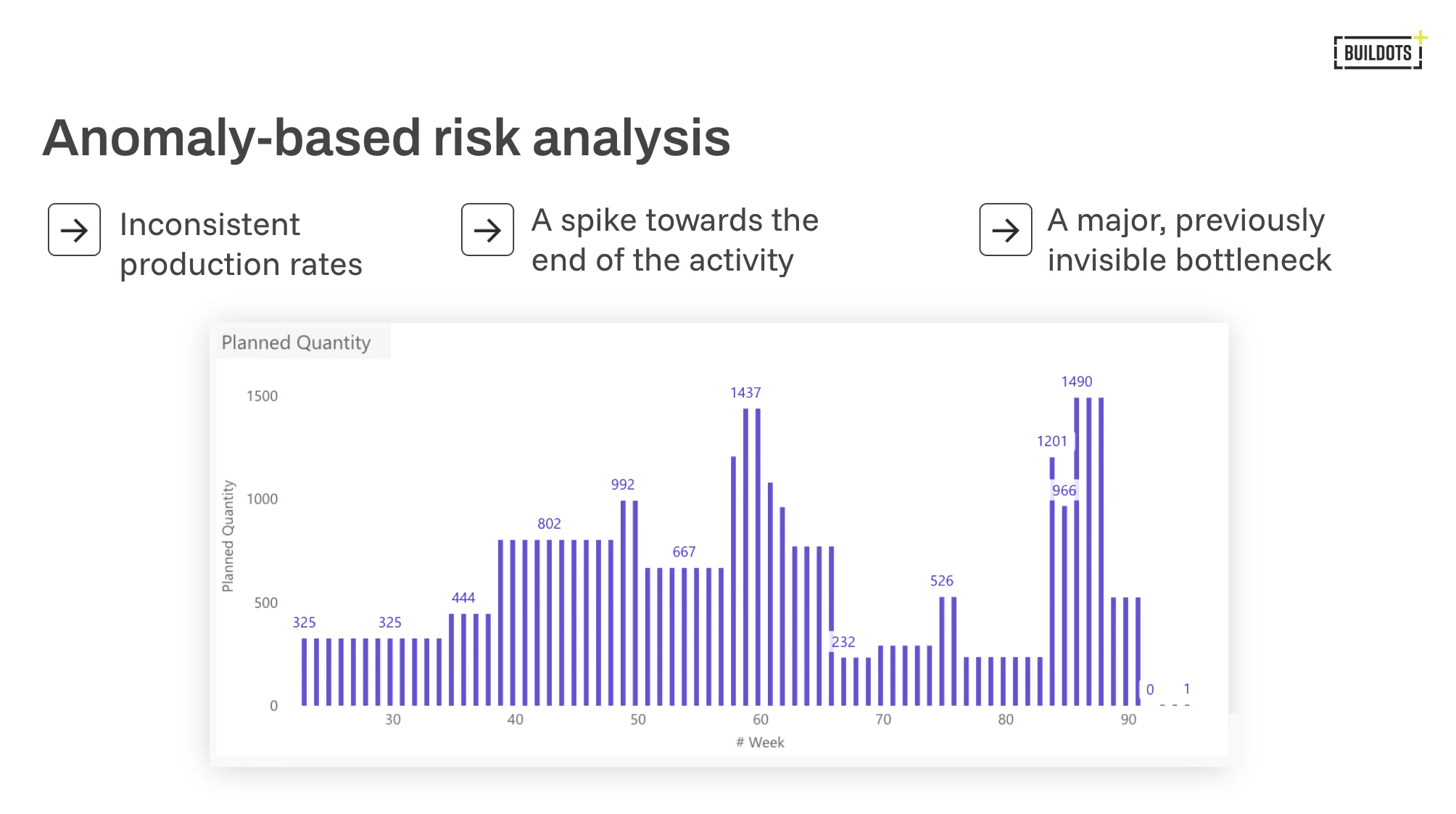
Importantly, a detected anomaly isn’t automatically an error; it’s a flag. As Berman put it, the pattern becomes “a base for conversation” – either the team confirms the scheduled production spike is intended and resourced, or the plan gets fixed while fixing it is still cheap.
4. Measure the plan vs. reality gap with production benchmarks
Schedule intelligence pressure-tests contractor commitments against real-world performance data.
Analysis of data center construction projects delivered using the Buildots platform revealed that the gap between a trade partner’s planned weekly output and actual site delivery typically ranges from 20% to 50%.
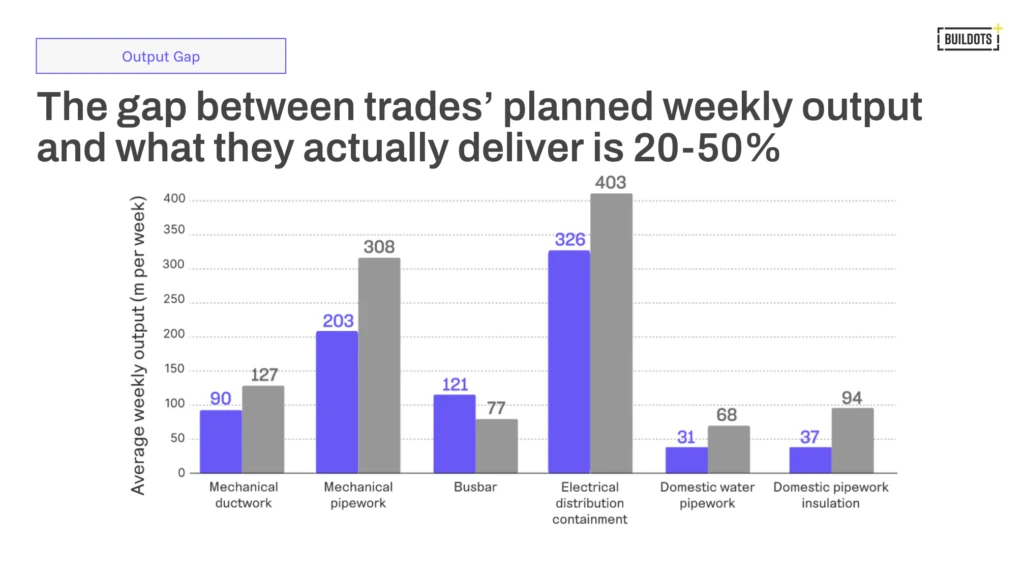
Across critical data center MEP activities, actual site output consistently lags planned expectations:
- HVAC System Installation: Achieves 76.9% of the pace required to maintain the schedule.
- Electrical Containment: Achieves 59.4% of the required pace.
- Domestic Water Distribution: Achieves 44.9% of the required pace
Access to empirical benchmarks changes pre-construction conversations. Instead of accepting overly optimistic bids, owners and general contractors can review production curves collaboratively with trade partners and adjust plans before commitments are locked.
5. Test delivery scenarios months ahead with data-driven simulations
Finding embedded schedule risks is half the battle. Understanding what to do about them is the other half. That’s where simulations can be helpful.
“You can run simulations not only to optimize, but also to understand risk.”
Kushal Dagli, Global Data Center Deployment Optimization Lead at Microsoft
Once a schedule is quantity-loaded and validated against actual production rates, it becomes more than a plan; it’s a model that can be tested.
Most project teams meet their schedule risks for the first time on site. By then, the options are expensive: acceleration, re-sequencing under pressure, or absorbing the delay.
Dagli argues there’s a fundamentally different approach available – one where the plan itself is put through its paces before a single crew mobilizes on the construction site. Using a simulation framework he developed for the data center construction sector, teams interrogate the schedule months before execution using simulations to understand where their schedule risks lie –and create plans ahead of time to mitigate those delay risks.
The simulation approach works in two modes. The first is deterministic –playing out specific what-ifs against the plan: “Let’s say, a particular piece of equipment was supposed to arrive, and that equipment is delayed by 30 days… what happens to that project?” The second is probabilistic, using Monte Carlo iterations to map the full distribution of possible outcomes using randomly varied conditions rather than a single optimistic path.
Together, Dagli says, these simulation methods let you “readjust your plan accordingly and set realistic expectations” – and, Dagli notes, they form “a good backbone for you to create a strong continuous improvement culture and mindset within your organization.”
The payoff shows up in the field: Dagli described identifying, through this data-driven simulation framework, that fire suppression installation was a recurring critical-path choke point across data center schedules. The industry-standard instinct to add manpower to fix this made things worse when tested: “We realized that it was actually constraining the other trades,” he noted. The data pointed to a different answer: breaking the trade into parallel work fronts, which eliminated the choke point without the congestion.
His broader point applies to any trade on any project: “You have to evaluate the flow, you have to evaluate the throughput, and you have to evaluate what rate you’re producing at… If you’re not doing that, then you’re really not going by the data, you’re going by your gut instinct.”
Better data. Better decisions. More predictable projects.
Construction teams have more project data than ever before. The challenge is turning that data into more timely, informed decisions and continuous improvement for project delivery.
Schedule intelligence requires a cultural shift as well as a technical one. Adoption fails when field teams experience data tools as corporate scorekeeping or surveillance instead of site enablement. Dagli is direct about where the line sits:
“Tech should not be viewed and used as a way of keeping a score. I think it needs to be incorporated in a way of enabling decisions and enabling decisions early.”
“I think it’s really about being able to make decisions as early in the process as possible by bringing partners together.”
That applies to benchmarks, too. Production data shouldn’t be used as an accusatory verdict handed down to trade partners, Dagli says, “You should use that as a means of a conversation to iron out the risks, to understand the capability of a particular partner that you’re bringing on board better, and to help them.”
Think of a general superintendent, the operational quarterback of a data center project, historically managing trade handoffs and scheduling risks on instinct and experience alone. “He’s doing it often without the data,” Dagli notes. “And what we’re saying here is that, [if you] do it with the data, you can have more transparent, more honest conversations, and you enable the decisions to happen before those issues occur.”
The takeaway for data center delivery teams: predictability isn’t achieved by tracking delays after they happen. It’s built before work begins – with quantity-loaded plans, verified production benchmarks, and early-stage simulation replacing abstract assumptions.
“Look at project planning and scheduling as a way of understanding the flow on a construction project, understanding the constraints, and understanding the throughput,” says Dagli, “You will be able to make your projects more predictable, improve the repeatability as well, and create a culture of continuous improvement.”
Want to see how schedule intelligence de-risks data center projects at scale? Watch the full on-demand webinar with Microsoft and Buildots here.