155 apartments stuck at 95%: The close-out wave your schedule didn’t plan for

By David Milnes
Industry Transformation Manager
share


In construction, we treat close-out rushes like sticky summer heatwaves. They’re unpleasant, inevitable, and ultimately, something you have to manage rather than have the power to prevent.
Recent research from the Buildots Intelligence Lab suggests that this approach may be compounding the problem.
What we looked at
We followed one high-rise residential project (250+ apartments, 30+ floors) from construction through to completion, looking at actual progress data captured unit by unit to try and understand what really happens in the last 5%.
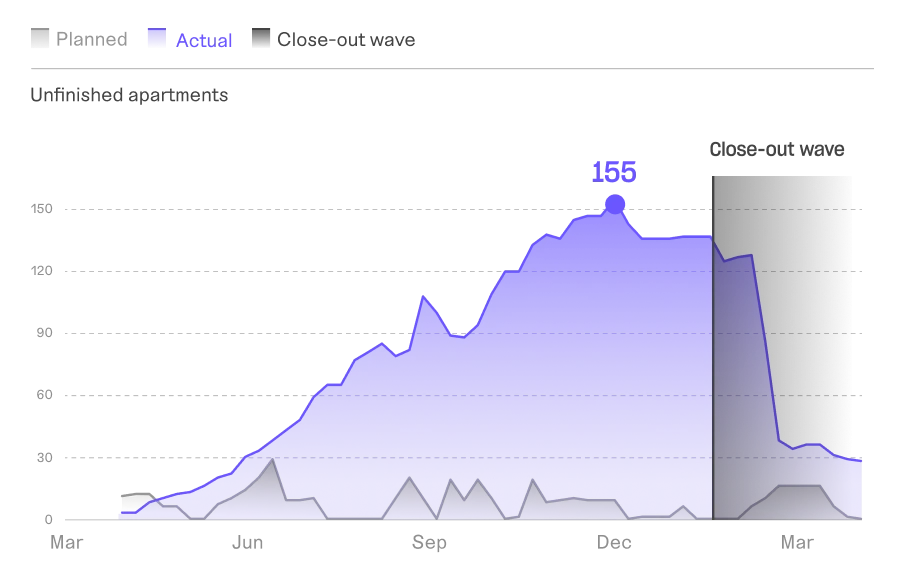
The schedule accounted for a steady trickle of close-out activities. What it got was a massive tidal wave of unfinished activity.
The plan was for apartments to pass through the final 5% smoothly, progressing steadily to handover with no more than around 30 units ‘nearly done’ at any point.
That is not what happened.
By the peak, 6 in 10 apartments were simultaneously sitting at 95-100% complete. Built, but not finished. The number of ‘almost finished’ apartments had grown to roughly five times what the plan anticipated. And rather than flowing through to handover, they sat in that state for months, until a wave of close-out activity across two months finished them all at once.
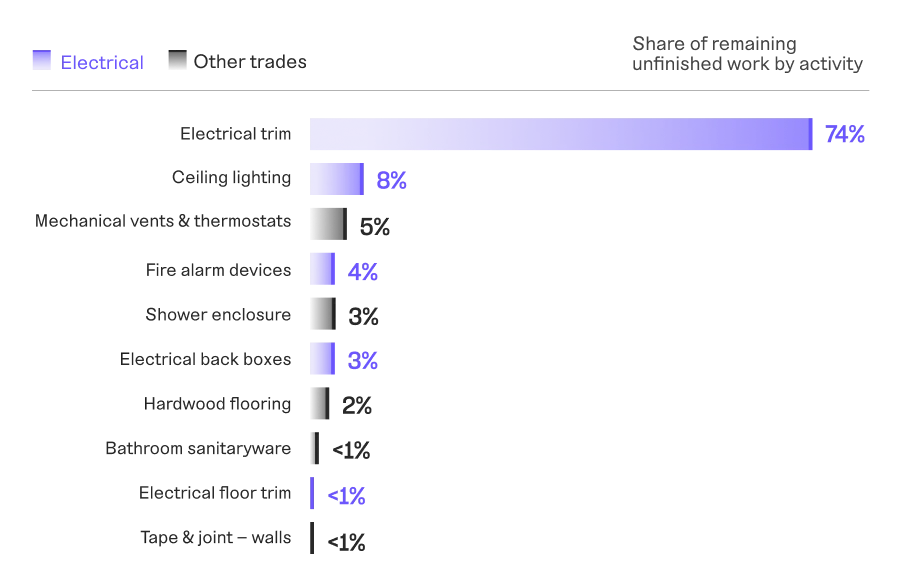
Most interestingly, that last 5% of unfinished work was almost exclusively the responsibility of a single trade. Around 74% of the residual effort in those stuck apartments was electrical trim, rather than a spread of minor items across many trades.
The electrical finishes had started roughly on time. The plan had them as a one-week sweep per floor. But the actual close-out dragged, floor after floor, slipping further and further behind as the project progressed. By the time the lowest floors finally closed out, they were around 10 months late against plan.
What can one project teach us about the industry?
Yes, this research is ultimately a case study, rather than a benchmark. Unlike other Lab insights, it didn’t involve a large pool of data. But we think that the pattern it reveals is one many people across the industry will recognize immediately, and certainly warrants a larger conversation.
“Looking at this data took me back to my days managing large-scale residential construction projects. There are knock-on consequences of not completing as you go, particularly in sign-off and de-snagging. This can lead to overwhelming levels of unplanned works and catch you out in the final stages,” said Mark Tant, Construction Consultant and former Managing Director at a large UK contractor.
From an operations perspective, this can be viewed as a compounding sequencing failure. The same people are pulled back repeatedly, across multiple floors, instead of working in a clean progression. In other words, the consequence of a close-out wave isn’t just late handover. It is a final stage that becomes structurally harder to manage. More trades in more places, more coordination overhead and more opportunities for items to fall through the cracks. Our earlier analysis of zero-progress weeks points in the same direction: stalls accumulate, and recovery becomes progressively harder the longer they go unaddressed.
Questions for project teams
The question this data poses isn’t whether close-out challenges can be eliminated. They probably can’t. The question is whether they have to pile up. Whether the accepted norm of a close-out wave is truly unavoidable, or whether earlier, more consistent monitoring of units approaching completion could distribute that effort more efficiently across the schedule.
Three questions we think are worth asking on any project:
- What are the risks of not completing as you go?
- What is the single biggest reason close-out doesn’t happen floor by floor?
- Should close-out progress be tracked as actively as structural progress?
We’d love to hear your thoughts. Get in touch with the Lab team.
David Milnes
Industry Transformation Manager