North America outpaces the UK with more work in progress – according to new data
Most project teams are taught a simple rule: to go faster, limit ‘Work in Progress’ (WIP). Or in other words, deliberately curtail the number of active work areas, units, or tasks that are open at the same time on a project.
The thinking behind this is that fewer open areas means less switching, fewer clashes, and more focus, so production should flow better.
We set out to investigate the accuracy of this acquired wisdom. And to do so, we compared thousands of apartments in residential high-rise projects across North America and the UK.
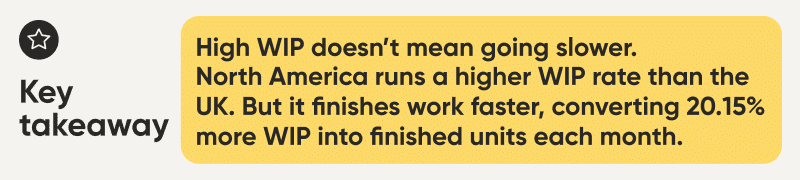
What we found surprised us. In reality, North America tends to have more WIP areas than the UK, but still finishes a higher ratio of open work faster. Allow us to explain how we arrived at this conclusion.
The ramp-up curve and the subsequent transatlantic divide
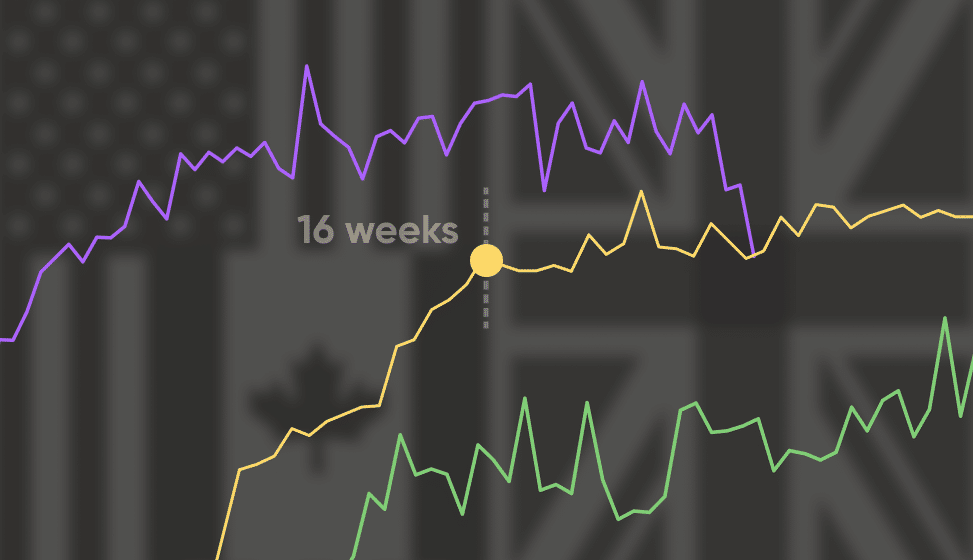
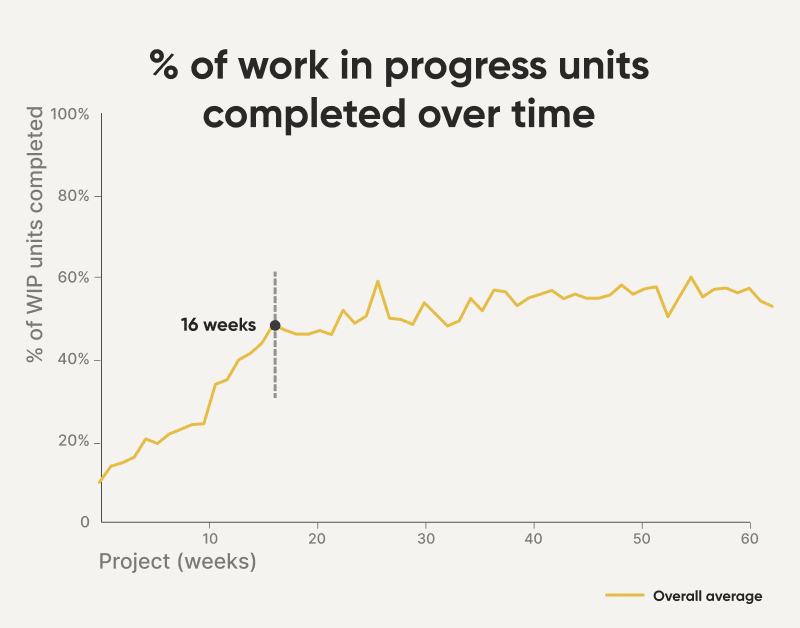
We used a 30-day sliding window to track the ratio of completed apartments (units) against WIP units per activity over time.
Across both geographies, we saw the same universal ‘ramp-up’. It takes roughly 16 weeks for a residential high-rise project to find its flow. After week 16, projects reach a ‘steady state’, consistently completing around 43-50% of the units currently in progress every 30 days. This plateau stays remarkably stable until the final weeks of the project.
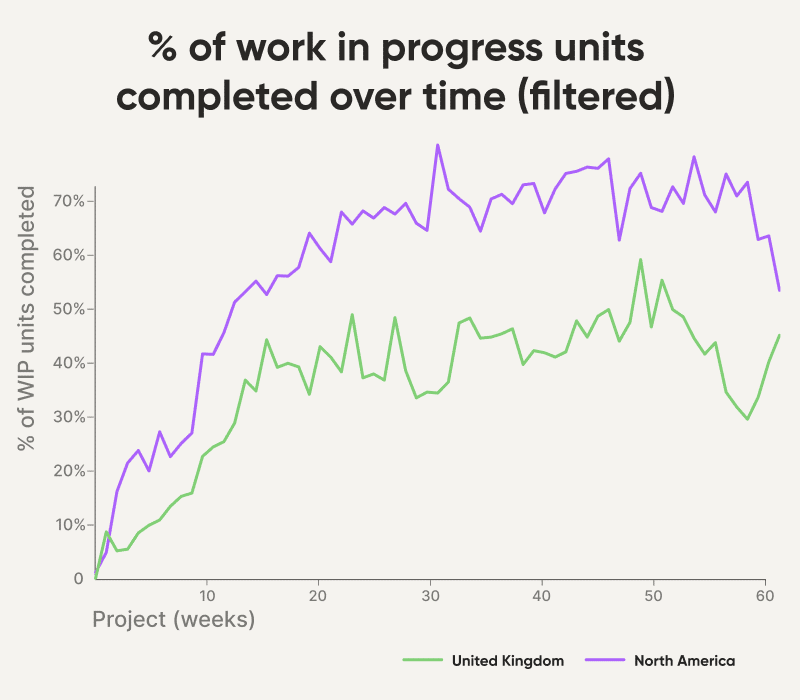
But when we broke the data down by geography, a clear performance gap emerged. While both regions follow the same 16-week ramp-up, they don’t reach the same steady-state level.
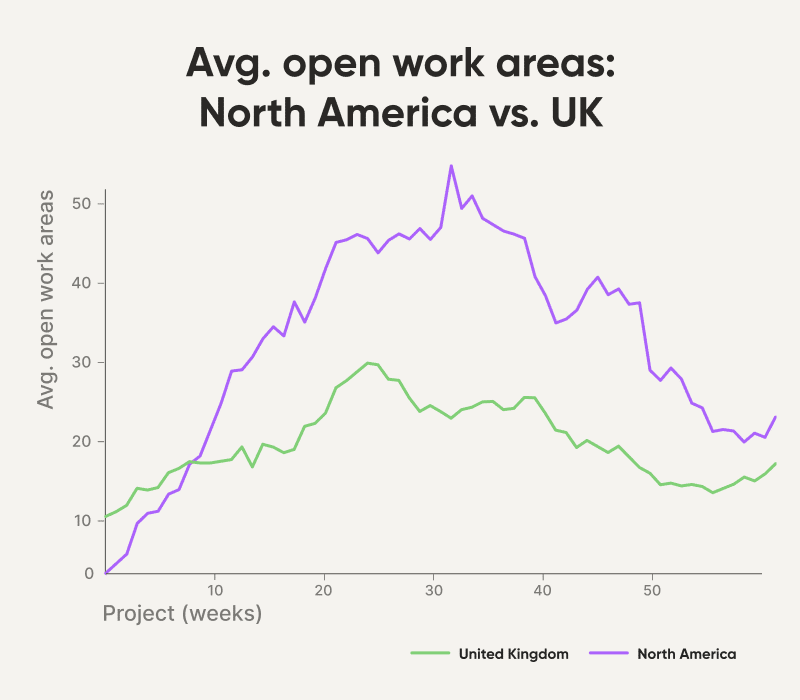
We also saw a significant difference between WIP areas in North America vs the UK. On average, North American projects manage a larger number of open work areas simultaneously.
Despite much higher WIP numbers, our data shows that North American projects outperform UK projects by a significant margin. They complete more total units per week, and they convert a larger percentage of WIP into finished units.
In fact, North American completion-to-WIP ratio is 20.15% higher than the UK’s on average.
How come? Asking the hard questions
The US market shows that scale and efficiency aren’t mutually exclusive – and it challenges conventional wisdom. If ‘more work open’ usually creates more drag, how is North America managing to defy the gravity of WIP?
Right now, we have the what. We’re still investigating the why. But the data pushes us to ask a few hard questions:
- Is it the planning and coordination model? Do NA teams use different scheduling or trade coordination approaches that let trades move through open areas with less friction?
- Is it the operating environment? Do supply chain structures, procurement norms, or labor specialization enable higher throughput without the congestion we see elsewhere?
- Is scale actually a catalyst? In other words, does running more concurrent workstreams create a ‘pull’ effect that increases momentum rather than slowing it down?
Of course, the takeaway for project leaders isn’t simply ‘increase WIP’! It’s to build the capability to handle more work at once without losing control, and still convert a high share of active work into completed units.
Moving from ‘what’ to ‘why’
We’re committed to understanding what’s driving this performance divide. Over the weeks and months ahead, we’ll dig deeper into the data to isolate the factors behind the gap. If we can identify what enables North American projects to sustain higher WIP without losing velocity, we can begin translating those lessons to the UK and beyond.
Want construction efficiency insights backed by real data?
Get our best weekly insights, curated into one monthly briefing.