Slow off the starting blocks: Why your revised schedule is still failing MEP and riser activities

Every project manager knows the routine: things change on-site, and the schedule gets updated to catch up. But even with a fresh plan in hand, do trades actually ‘get going' when the updated schedule says they should?
We dug into the data to find out.
What we measured
First, a quick note on our methodology. We analyzed the median gap between when dozens of projects planned to get going versus when they actually did, measured in weeks.
We define ‘getting going’ as the point where 10% of an activity's scope is complete. This filters out minor early work (like a single pipe or a few meters of containment) and captures the moment a trade has truly begun meaningful production in a zone.
Crucially, all measurements are taken against the most recent schedule, not the original baseline. We analyzed dozens of global projects, and specifically selected ‘high interest’ activities to avoid having an excessively long list.
MEP and riser activities routinely get going 5-10 weeks late
What's notable is that nearly all the most delayed activities belong to M&E 1st fix and sprinkler systems. MEP and riser activities are routinely 5 to 10 weeks late to get going, even against the most recent schedule.
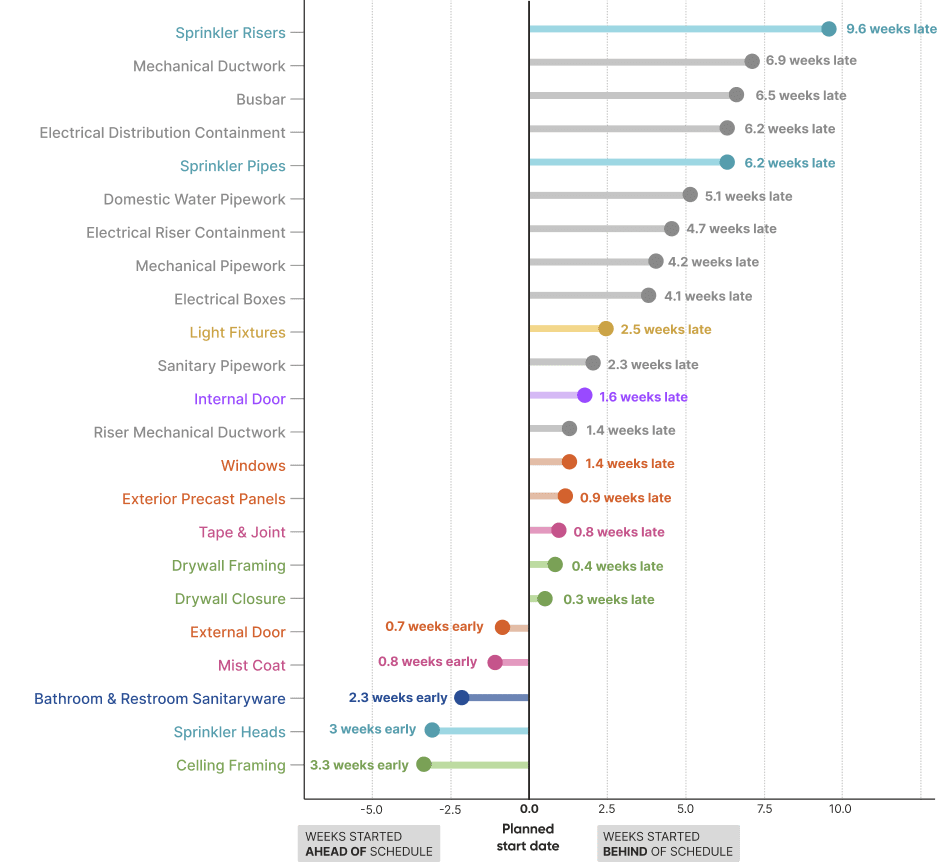
For example, sprinkler risers get going 9.6 weeks late. Mechanical ductwork follows at 6.9 weeks. Busbar, electrical distribution containment, and sprinkler pipes are all in the 6-7 week range. Lastly, electrical riser containment is 4.7 weeks late to get going.
You don’t need me to tell you that these aren’t marginal delays to getting going – some stretching for over two months! And because other trades depend on M&E rough-in being in place before they can progress, the impact cascades downstream. It’s a similar situation with risers. They’re the project’s vertical backbone, yet they remain a chronic bottleneck. When the time it takes for a riser activity to get going starts to slip, the resulting squeeze on commissioning is almost impossible to recover from.
This raises questions about how these trades get going in practice. Is design information ready when they need it? Do procurement timelines align with construction schedules? Are we simply consistently underestimating the lead time required for these complex activities to get going?
Finishing trades are surprisingly ahead of plan
At the other end of the spectrum, ceiling framing gets going 3.3 weeks early, sprinkler heads 3.0 weeks early, and bathroom and restroom sanitaryware 2.3 weeks early.
This might seem counterintuitive. How can decorating and finishing activities, which typically come after M&E 1st fix in the build sequence, start ahead of schedule when M&E is lagging?
The answer lies in what we're measuring. Finishing work can often begin in areas unaffected by M&E delays. Whether it's the single side of a partition wall or a specific room where services are already roughed in, these teams are finding pockets of work they can start while waiting for the rest of the floor to catch up.
What does this mean for me?
The implications for project teams are significant:
- For planners: Production rate benchmarks are important, but they assume the trade is already going and working. If your schedule allocates eight weeks for mechanical ductwork on a floor but the trade doesn't meaningfully get going until nearly seven weeks after the plan, you've already used most of the window before a single piece of duct is meaningfully installed. Planning needs to account for this gap.
- For project leaders: Being late to get going on MEP doesn't just delay one trade. It compresses the timeline for everything that follows: containment, pipework, testing, commissioning, etc. Every week it takes to get going is a week less for recovery. And as our previous research on what happens when work stops shows, once a trade falls behind, the recovery is rarely clean.
The consistency of this pattern suggests the problem isn’t poor individual management, but something endemic. Whether the root cause of complex activities being slow to get going is late design, misaligned procurement, coordination friction or something else entirely, one thing is clear: the current approach to starting complex services isn't working as planned.
Want construction efficiency insights backed by real data?
Get our best weekly insights, curated into one monthly briefing.