Data analytics in construction: Why a lack of structured data is stalling AI’s takeoff

For decades, the construction industry has fought a losing battle against gravity. We are weighed down by razor-thin margins, high risk, and the immense complexity of managing one-off projects. We move from job to job, starting from scratch every time, unable to truly learn or leverage insights from one site to the next.
We face a fundamental truth: You can’t improve what you don’t measure, and you can’t measure what you haven’t standardized. While many firms have launched impressive initiatives to standardize construction data within specific departments or projects, we have not yet reached the critical mass required to scale data analytics in construction.
Then came the AI boom. Suddenly, the industry is awash in optimism. We see generative design, automated scheduling, and chat agents that promise to solve our efficiency crisis. It feels like we’re finally about to take off.
AI represents the first true opportunity in our lifetime to achieve escape velocity – to finally break the cycle of low margins and fundamentally change the economics of AEC.
But to break through, we need more than just better software. We’re buying the engines, but we haven't got the fuel. In other words, the industry’s AI revolution faces a limit because our tools are starving for the one thing Silicon Valley cannot sell us: a well-structured, vertical, and large-scale data layer.
The division of labor: Why construction data is the missing fuel for AI engines
To understand the challenge, we have to look at who builds what.
Silicon Valley is building the engine. They’re spending trillions of dollars and hiring the world’s best talent to develop chips and AI models. They’re brilliant at building the machine. The good news for us is that we don't need to reinvent this wheel. We can simply repurpose these incredible engines for the AEC world. But Silicon Valley cannot refine the fuel – contextual construction data. This fuel is the deep, messy, complex reality – the granular detail of how a semiconductor plant is framed or how a hospital’s MEP systems are coordinated.
General AI is powerful, but it is generic. It can write a poem, summarize a meeting, or “vibe code” a demo of a new app in seconds. But without vertical data (structured information specific to the reality of construction), its power is limited. General AI can't execute the sophisticated data analytics in construction needed to predict a supply chain bottleneck at an enterprise scale or explain why your margins eroded on the last three projects in the Midwest.
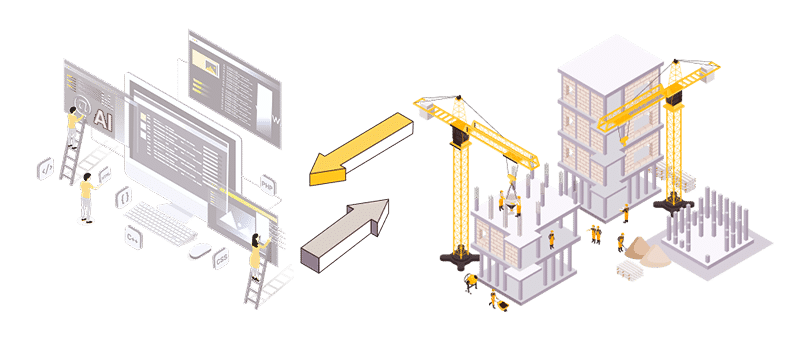
In a successful construction data strategy, builders command and tech delivers
So, how do we bridge the gap?
Let’s be realistic. Construction organizations are builders. That is your craft, your expertise, and your core business. You generally don’t have the capital structure for R&D, nor the in-house expertise to build complex data infrastructures on your own.
Many leaders have already taken the first brave steps, establishing VDC teams and implementing BIM standards. But to power the next generation of AI, we need to go further. We need a larger, dedicated, and coordinated partnership between builders and the tech ecosystem.
Construction organizations (owners, general contractors, specialty contractors, etc.) must work with the tech sector to execute a scalable construction data strategy. We, as construction tech vendors, exist to do the heavy lifting here – building the pipelines, intake tools, and analytics layers.
But to scale data analytics in construction, we need to define the destination together. This means working to jointly establish and define:
- The flow of information – so the hard work you’re already doing translates into AI-ready assets
- Organization-wide data modeling standards that go beyond individual projects
- Your data IP – and the resources required to capture it
Taking the front seat: Active governance for successful data analytics in construction
The approach I described above is known as active governance. It’s characterised by a “leadership” mindset from the c-suite down to the project executive, where building the right data infrastructure becomes a priority.
Don’t worry. This doesn’t mean everyone needs to be technical or become a coder. It simply means doubling down on structured data – evolving the expectation from simply “collecting files” to actively demanding “structured deliverables”. It means refusing to accept “digital exhaust” – unstructured PDFs, messy Excel sheets, and siloed data sets – as a final outcome.
If you’re a construction leader, it is time to elevate your data mandate to:
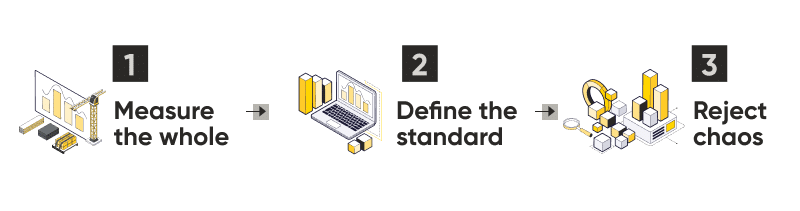
- Measure the whole: Launch business-wide initiatives to capture and integrate construction data across the entire organization, treating the portfolio as a single, measurable entity rather than a collection of fragmented projects.
- Define the standard: Coordinate with tech partners to set ground rules for how data is collected, organized, and modeled across your entire portfolio.
- Reject chaos: Accelerate the shift away from treating data as a byproduct. Data is now an asset equal to the physical building.
No one else will do this for us. Industry leaders must assume the stewardship of this essential infrastructure. If we wait for the tech giants to guess how we build, we resign ourselves to waiting forever.
The 10x multiplier: Unleashing construction efficiency with data analytics
Why go through the trouble? Why add this layer of governance to an already stressed industry?
Because the upside is escape velocity.
The powerful engines (AI and machine learning tools) are being delivered in front of us, but we need to create and refine the fuel (the structured data layer) together. When we do, we effectively unlock a 10x multiplier on every AI tool we touch:
- Scale: Suddenly, you aren't optimizing a single job site. You’re optimizing a billion-dollar portfolio, spotting trends across regions and for years ahead.
- Speed: You gain the ability to identify bottlenecks, whether organizational or operational, before they impact the schedule. You stop performing reactive analysis and start executing predictive prevention.
- Strategy: You connect your teams to what really matters. Instead of drowning in noise, they’re guided by insights that align with company-wide objectives.
The call to arms: Ready to tackle the construction data challenge?
The technology is ready. The world has handed us the most powerful AI engines in history.
But a rocket sitting on the launchpad with an empty tank cannot reach orbit. The difference between the construction firms that will dominate the next decade and those that struggle to survive won't be who bought the most software licenses. It will be who built the best data layer to power that engine.
If we don't govern the construction data today, the potential for scalable data analytics in construction stays grounded. It is time to take the front seat. Are you ready?
Want construction efficiency insights backed by real data?
Get our best weekly insights, curated into one monthly briefing.